

The Farrier Schedule
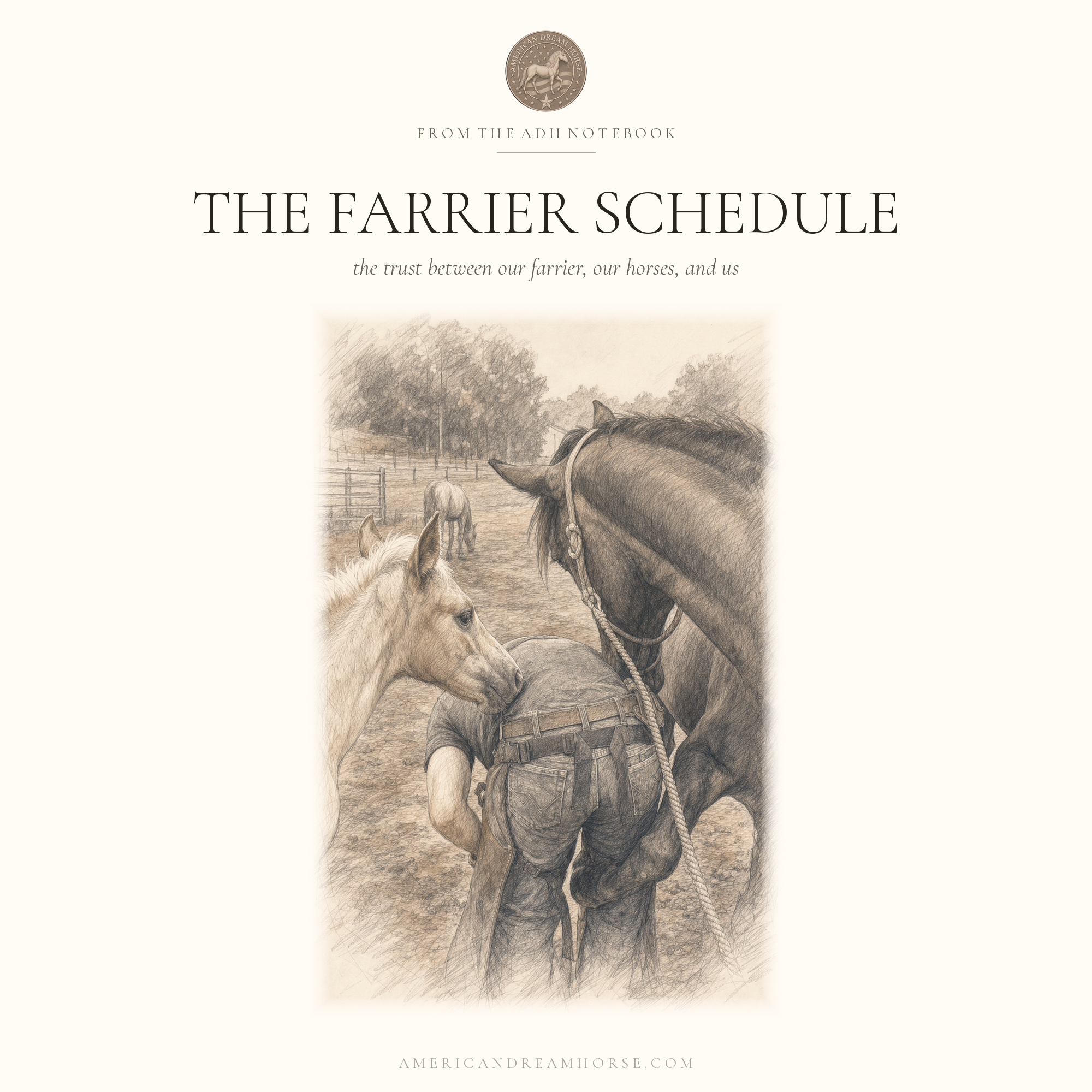
Every five to six weeks, Shane pulls into the drive.
He has been our farrier for more than six years. He is good at his craft, and he is good with our horses. With the babies who have never seen a rasp, with the seniors whose joints ask for a slower rhythm, and with everyone in between.
That matters to us. A farrier who is kind to a foal in April is the same farrier a mare will trust in her twenties.
Barefoot, with a few exceptions
Every horse at American Dream Horse is barefoot except our main riding horses, who wear borium shoes for trail riding.
We ride in the foothills of Tennessee, Alabama, Kentucky, and the surrounding states. Creek crossings, wet limestone, moss-slick rock, roots pulled tight over ledges. Borium gives the shoe a bite the terrain will not give a bare hoof. Everyone else stays barefoot year round. The mares, the stallions, the foals and retirees.
What we feed, and why it shows up in the hoof
Rockies have great feet with a dense wall, a tight sole, an honest angle. It is part of what makes the breed what it is. A horse bred in Appalachian country by people who could not afford to shoe every horse and needed a foot that would hold up on rock.
But good genetics only carry you so far and nutrition does the rest.
We feed good-quality grass hay, loose minerals, loose salt, and a good-quality feed that is not full of sugar and starch. That is the whole program. We do not use a hoof supplement, and none of our horses have ever needed one. Even here in Middle Tennessee, where we get more rain than Seattle.If the diet is right, the hoof will hold up to a wet climate on its own.
If you are looking at a Rocky with cracks, chips, thin walls, or slow growth, the first place to look is not the farrier. It is the feed room.
What we ask of the horses on trim day
Every horse here is expected to stand calmly for trims. A horse asking to set a foot down for a moment is not being difficult. They can have a break to rebalance themselves when they need one. But naughty behavior is corrected, and every horse on this farm learns our expectations from the beginning.
It is our job to keep our farriers safe. Shane trusts us to hand him a horse he can work on, and we take that seriously.
Foals learn from watching
Our foals are introduced to Shane from the first time he comes after they are born. They stand nearby while their dams are trimmed, and they watch. Curious about the rasp, the nippers, the low sound of the file working across a hoof.
We do not trim foals at a few weeks old. We do not need to. But we do introduce them to the tools, and we practice. Llifting each hoof, holding it, balancing on three legs while a hand runs across the frog and the wall.
By the time Shane picks up a foot for the first real trim, nothing about the process is unfamiliar. The farrier is not a stranger, the stand is not a fight, and the picking up of a foot is something they have watched their mother do a hundred times without protest.
That is not accidental. It is why we handle feet from the day a foal is born, it is why we imprint, and it is why the first trim is quiet.
The standard, in a sentence
Every horse at ADH picks up all four feet on cue and stands for the work. If they need a moment, they get one. If they need a correction, they get one. If they need training, we train them between visits. Not on Shane's time.
The standard is the standard.
From the ADH farm to yours.